
Stop Tracking Keywords by City: Why Hyper-Local Radius Data Wins the Map Pack
I’m going to tell you something that most SEO agencies are too afraid to admit: your “City-Level” ranking reports are a total lie. If you are still celebrating because a tool tells you that you are #1 for “Plumber in Chicago” or “Personal Injury Lawyer in Miami,” you are likely looking at a vanity metric that has zero correlation with your actual lead flow. In the world of google business profile seo, the concept of “ranking in a city” is an outdated relic of 2015. In 2025 and 2026, the only metric that matters is hyper-local radius data.
Section 1: The “City Ranking” Lie
For years, the industry standard has been to track a single data point. You pick a keyword, you pick a city, and the software tells you where you stand. But here is the reality: Google Maps does not see a city as a single, uniform block. It sees a city as a collection of thousands of individual GPS coordinates, each with its own unique competitive landscape.
If you are sitting in your office and search for your services, you might see yourself at the top of the Map Pack. But if a potential customer walks just three blocks to the West, or drives two miles South, your business might vanish from the top three entirely. This is the “Proximity Gap,” and it is the silent killer of local businesses. Traditional tracking tools often pull data from the “centroid” (the geographic center of a city) or from the business address itself. This gives you a skewed, overly optimistic view of your visibility.
The turning point for this shift was the Vicinity Update in December 2021. This was the moment Google fundamentally re-weighted the algorithm to prioritize distance over almost everything else. It effectively “shrank” the ranking radius for businesses, making it much harder for a business in one neighborhood to show up for a searcher in another. If you aren’t using a google maps rank tracker that accounts for this micro-volatility, you are essentially flying blind.
Section 2: Understanding the 2026 Map Pack Formula
To dominate the local search landscape today, you have to understand that the algorithm has evolved beyond simple keywords and citations. While the three core pillars of Local SEO – Relevance, Distance (Proximity), and Prominence – remain the foundation, the way Google calculates them has become incredibly sophisticated.
We are now entering the era of “Entity Proximity.” Google isn’t just looking at where your business is physically located; it’s looking at how deeply your business “entity” is tied to specific neighborhood signals. The 2026 Local Algorithm has introduced two critical new factors: Micro-Trip Signals and Active Signal Velocity.
Micro-Trip Signals refer to the cross-device user paths Google tracks. If Google sees that users frequently search for your business while they are physically located in a specific 1-mile radius, your authority in that specific radius spikes. Active Signal Velocity measures how quickly users interact with your profile (calls, direction requests, website clicks) from specific coordinates. This data allows Google to determine if you are a “neighborhood fixture” or just a business that happens to be nearby. To stay ahead of these shifts, you need a comprehensive google business profile audit tool that can analyze these deeper signals.
When you focus on google business profile seo, you aren’t just optimizing for a search engine; you are optimizing for a geographic coordinate. For more on how these signals are evolving, check out this guide on Mastering GMB Rankings: Proven Strategies for 2025.
Section 3: Why Radius Data (Heatmaps) Wins
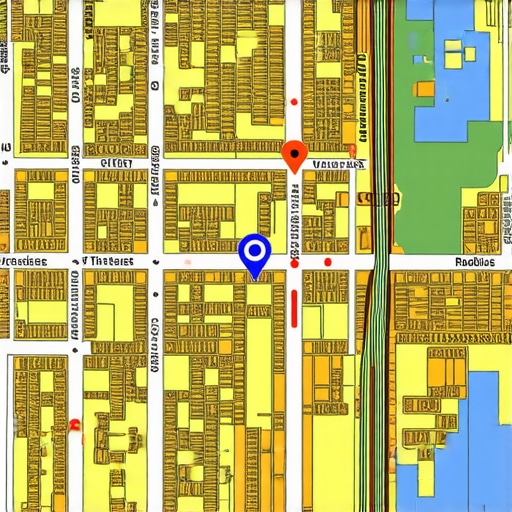
If city-level tracking is the lie, then Grid Tracking (Heatmaps) is the truth. A heatmap doesn’t just give you one number; it gives you a visual representation of your dominance across a map. Imagine a 13×13 grid laid over your city, where each point on the grid represents a specific GPS coordinate. A heatmap tool will run a search for your keyword at every single one of those 169 points.
The results are often eye-opening. You might find that you are #1 at your office, #3 two blocks away, and #14 just a mile down the road. This is what we call a “Ranking Gap.” By using local seo software that provides this level of granularity, you can identify exactly where your relevance starts to fade.
The technical advantage of radius data is that it reveals geographic relevance problems. If your heatmap shows you rank well to the North but fail to the South, you don’t have a general SEO problem – you have a South-side signal problem. Perhaps there is a physical barrier like a highway or a river that Google perceives as a boundary, or perhaps a competitor in the South has stronger “Active Signal Velocity.” Without a google maps rank tracker, you would never know to target your efforts in that specific direction. You can find more about these tools in our list of 7 Tools That Actually Reveal Your True Map Position.
Section 4: Vertical-Specific Proximity Challenges
Not every industry is treated the same by the proximity algorithm. The “radius of influence” varies wildly depending on what you do.
Contractors, Plumbers, and HVAC (SABs)
Service Area Businesses (SABs) face the toughest battle. Since they don’t have a physical storefront for customers to visit, Google is often stingier with their ranking radius. I often see plumbers who dominate their home zip code but hit a “hard wall” the second they cross the town line. This happens because Google lacks “Physical Proximity Signals” like foot traffic to verify their presence in the neighboring town. This is why understanding Why Your Local Visibility Hits a Hard Wall at the Town Line is crucial for any contractor.
Law Firms and Dentists
For professional services like law firms or dentists, the proximity test is even more localized. Most patients or clients aren’t willing to drive 20 miles for a cleaning or a consultation if there are five high-rated options within 3 miles. If you are a dentist optimizing for “[City Name] Dentist,” you are competing with every office in the metro area. But if you optimize for the 2-mile radius where your patients actually live, you can dominate the Map Pack for the searches that actually convert. Many practices fail because they ignore the Physical Proximity Signals Most Map Ranking Experts Forget to Check.
To fix this, you need to use local seo ranking tools to see where your competitors are stealing your “neighborhood” traffic. A Deep Business Profile Audit can often expose these hidden blind spots in your geographic reach.
Section 5: Moving from “Local” to “Hyper-Local” Strategy
So, how do you actually win in a world dominated by proximity? You stop thinking about the city and start thinking about the block. Here are three actionable steps to rank higher on google maps by building hyper-local relevance.
1. Neighborhood-Specific Content
Stop writing generic blog posts about “Plumbing Tips in Chicago.” Start writing about “How the Hard Water in Lincoln Park Affects Your Pipes” or “Emergency HVAC Repair Near the United Center.” Mention specific landmarks, intersections, and local districts. This tells Google’s NLP (Natural Language Processing) that your business is an authority for that specific coordinate, not just the general city area.
2. Signal Depth and “Ghost Signals”
Google is now using what I call “Ghost Signals” to verify your local authority. These include Bluetooth pings from mobile devices, Wi-Fi network data, and even aggregate foot traffic patterns. While you can’t “fake” these, you can encourage them. Run a local promotion that requires people to check in at your physical location, or partner with a neighboring business for a cross-promotion. This increases your “Active Signal Velocity” in a way that traditional citations never could.
3. Use Professional GBP Ranking Tools
You cannot manage what you do not measure. You need to be monitoring your grid tracking weekly. If you see a dip in a specific neighborhood, you need to respond immediately with localized content or a targeted review campaign from customers in that area. Using GBP ranking tools or GMB ranking tools is no longer optional – it is a requirement for survival in 2026. This is the core of modern local map pack seo.
Section 6: Conclusion & Call to Action
The era of “City-Level SEO” is dead. If you are still relying on reports that show you a single ranking for an entire metropolitan area, you are making decisions based on incomplete and misleading data. To win the Map Pack in 2026, you must embrace hyper-local radius data. You must know exactly where your visibility starts and where it ends.
By shifting your focus to grid tracking and neighborhood-specific signals, you can stop chasing vanity metrics and start capturing the high-intent traffic that is literally right outside your door. It’s time to perform a deep audit of your profile and see the truth for yourself. If you’re ready to stop guessing and start growing, utilize the power of SEO Viper Tools to uncover your true map position and dominate your local market.