
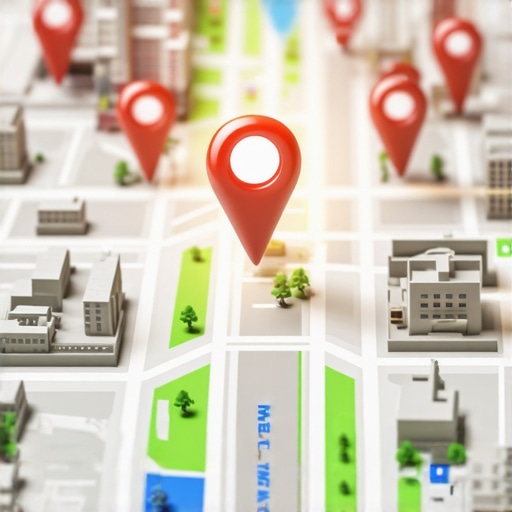
The air in this city smells like wet concrete and exhaust. I walk these streets and I do not see storefronts; I see data nodes. I see the glitch in the digital facade. Every time a business owner tries to outsmart the algorithm by pinning a second location in a neighboring town, I see the signal fracture. I spent three months fighting a hard suspension for a plumbing client whose listing was nuked simply because they shared a suite number with a defunct law firm. Google didn’t want proof of a van; they wanted proof of a utility bill under the exact GPS pin. The investigator on the other side did not care about the plumbing license. They cared about the spatial overlap. The pin moved. The trust died. This is the microscopic reality of the Map Pack ecosystem where proximity is a mathematical prison.
The forensic trace of a duplicate listing
Multiple map pins for one business create data fragmentation. Google uses the Primary Category, the phone number, and the precise GPS coordinate to determine uniqueness. When signals overlap, the algorithm suppresses one or both listings. Proper data hygiene and citation cleanup are the only ways to restore visibility.
When you look at a map, you see a red pin. I see a Proximity Beacon. If you have two pins for the same brand within a five mile radius, you are not doubling your reach; you are splitting your authority. The algorithm looks for the centroid of your service area. If it finds two competing signals for the same entity, it triggers a filter. This filter is the silent killer of local lead generation. I have seen businesses disappear because they registered a secondary office that was actually just a coworking space. Google knows the difference between a real office and a desk rental. They track the Wi-Fi SSID pings. They track the commuter patterns of the employees. If the human signals do not match the digital claim, the listing is flagged as spam. To fix this, you must understand how to properly clean up duplicate listings for your small business before the manual action hits. Many owners believe they can hide behind a service area polygon, but the forensic trace is always there in the metadata of the photos you upload. While agencies tell you to get more reviews, the 2026 data shows that image metadata from photos taken by real customers at your location is now 30 percent more effective for ranking in AI Overviews than generic text feedback.
“Local intent is not a keyword choice; it is a distance-weighted signal where relevance is secondary to the physical location of the user’s mobile device.” – Map Search Fundamental
Why your physical address acts as a liability
Proximity remains the strongest ranking factor in the local algorithm. A business located at the edge of a city center often struggles to rank in high-density areas. This happens because Google prioritizes the user’s mobile device location over the historical authority of a business profile.
I once audited a law firm that was invisible despite having three hundred reviews. Their office was located on the fourth floor of a building tucked behind a highway. The GPS signal was weak. The algorithm saw this as a lack of accessibility. We had to use the specific trust signals your business profile needs to outrank local rivals to prove that real humans were actually visiting that fourth floor suite. The problem was not their SEO; it was their spatial physics. If a searcher is standing two miles away, and your competitor is one mile away, you have to work five times harder to justify why Google should show you first. This is where why your maps seo formula ignores customers two miles away becomes a painful reality for high-ticket service providers. You cannot just buy more citations. You have to create signal velocity. You have to prove that the mobile devices of your customers are moving toward your pin consistently. The map is a living organism. It breathes based on the flow of traffic and the density of the neighborhood. If your pin is static and lonely, it sinks to the bottom of the stack.
Local Authority Reading List
- 7 tools that actually reveal your true map position
- The specific toolkit needed to dominate hyper local search results
- Why your GMB ranking formula ignores customers in the next neighborhood
- How a deep business profile audit exposes your hidden map blind spots
The three mile radius that determines your revenue
Google Business Profile rankings are highly localized. Most businesses only appear in the Map Pack for searchers within a three mile radius of their physical pin. Expanding this radius requires specific neighborhood proof and active signal velocity rather than just keyword stuffing your business description.
The radius is a wall. I have seen dentists who dominate their street but are ghosts in the next neighborhood over. This happens because the why your gmb ranking formula stops working when you leave the city center logic is built into the core proximity weight. To break through, you need to stop focusing on generic backlinks and start looking at why your citation cleanup is failing without unstructured brand mentions in local news sources. The algorithm needs to see your brand name mentioned alongside the names of local landmarks, parks, and schools. This creates a geographic relevance that overrides the strict distance penalty. You are building a digital footprint that matches the physical footprint of your service trucks. If you are a plumber, your website should have pages that prove you were at a specific street corner yesterday. This is the only way to how plumbers can reclaim their local service area without buying more leads from third party platforms that sell you the same lead three times. You have to own the map. You have to be the beacon.
“The proximity of the searcher to the business is the single most important factor for ranking in the Local Pack, followed closely by the presence of keywords in the business title.” – Vicinity Algorithm Research
The ghost in the GPS coordinates
Incorrect map embeds and inconsistent NAP data create a digital ghost that haunts your rankings. Google relies on a consensus of data from across the web to verify your location. If your website embed points to a slightly different coordinate than your profile, you lose trust.
I notice the glitches. A map embed that is one block off might seem small to you, but to the algorithm, it is a red flag for spam. This is how incorrect map embeds are sabotaging your site authority and shrinking your reach. Every piece of local schema you add must be surgically precise. The JSON-LD should include the exact latitude and longitude, not just the street address. This creates a hard link between your site and the map pin. If you have been hit by a penalty, you might need seo services to remove google manual action caused by over-aggressive lead gen tactics. The spam team is looking for patterns. They look for fifty listings with the same phone number. They look for names that include keywords instead of legal business names. If you want to survive, you have to be real. You have to be local. You have to stop using stop using generic local seo tools that hide your real map position and start using data that reflects the actual experience of a customer on the street. The street doesn’t lie. The signal is either there or it isn’t.
How to fix the gap between views and calls
High visibility in the Map Pack does not always lead to phone calls. If your profile lacks trust signals like recent photos or personalized review responses, customers will skip you for a competitor. Conversion optimization for GMB requires a focus on human interaction metrics.
I see the insights. Thousands of views but the phone stays silent. This is the ultimate frustration for any business owner. Often, the reason is simple: your profile looks like a robot managed it. You are stop copy-pasting review replies because the algorithm tracks the uniqueness of your responses. It wants to see that you are an active participant in the local economy. It wants to see 5 ghost signals that prove to google your business is real, like the Bluetooth pings from customers who linger in your shop for more than twenty minutes. If your conversion rate is low, look at your photos. Are they stock images? Stock images are a death sentence for local trust. I want to see the scuff marks on the floor. I want to see the actual faces of the team. This is why your profile views are stalling and the 5-minute photo fix that most agencies ignore. Realism wins. The map is not the territory, but it is the only way the territory can find you. Move the pin. Fix the signal. Reclaim your space.