
Why Your Local Listing Tools Aren’t Showing You the Real Competition
I spent three months fighting a hard suspension for a plumbing client whose listing was nuked simply because they shared a suite number with a defunct law firm. Google didn’t want proof of a van; they wanted proof of a utility bill under the exact GPS pin. They wanted to see the grain of the concrete where the van was parked in the morning. As a street photographer of the digital world, I see these glitches in the data every day. The storefront might look perfect to the naked eye, but the proximity beacon is flickering. Most agencies look at a rank tracker and see a green number; I look at the map and see a distorted reality. Smelling the wet concrete after a rain, I realize that local search isn’t about keywords. It is about spatial truth. If your data has a single mismatch, the local algorithm treats it like a blurry photo. You are out of focus, and therefore, you are invisible.
The ghost in the GPS coordinates
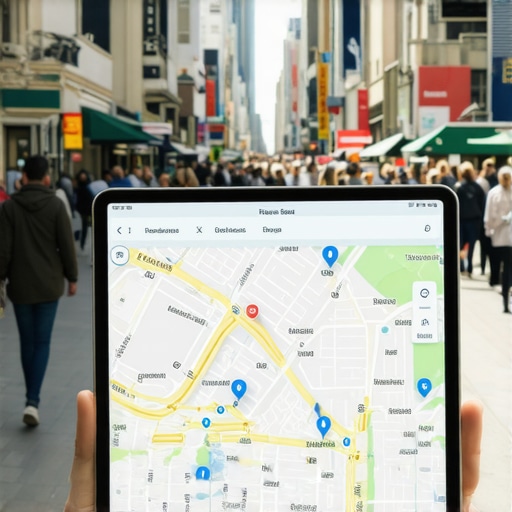
Google Maps competition is governed by coordinate salience and proximity signals that traditional SEO tools often fail to capture accurately. Your business location acts as a proximity beacon, and its ranking power fluctuates based on the user’s physical distance and the centroid density of the surrounding area. Most rank trackers show a static position, but the reality is a shifting grid where your visibility can vanish fifty feet from your door. This is why many owners need the tool settings that actually move your map pin upward rather than generic reporting. I have watched high-authority sites fall because their longitude and latitude didn’t align with their actual entrance. The algorithm is forensic. It calculates the time it takes for a mobile device to travel from a search location to your door. If that math doesn’t check out, you aren’t in the game. You are just a ghost on the map. This is why you must understand why most map tools give you the wrong ranking data when you are trying to scale.
“Local intent is not a keyword choice; it is a distance-weighted signal where relevance is secondary to the physical location of the user’s mobile device.” – Map Search Fundamental
Why your physical address is a liability
Google Business Profile suspensions often stem from address inconsistencies or shared suite numbers that trigger algorithmic spam filters. A physical address can become a ranking liability if it is associated with duplicate locations or virtual offices, leading to a hard suspension that requires professional reinstatement services. I have seen businesses get wiped out because they tried to hide their address after a ranking drop. If you are struggling, you should look into the honest recovery guide for suspended local listings to find a path back. The system is rigged against the ‘address rental’ crowd. Google wants to see a sign on the door. They want to see the service trucks in the driveway. If you are a service area business, you need the beginner move for getting your service area business noticed without triggering a red flag. Any hint of mixed language or inconsistent NAP data will lead to a deranked website. Clean data is the only currency that matters in the Map Pack. If your profile is stuck in a filter, you might need the signal cleanup every banned business listing needs to restore your trust score.
Local Authority Reading List
- https://maprankingformula.com/why-your-map-rank-dropped-after-that-business-name-change
- https://maprankingformula.com/the-honest-recovery-guide-for-suspended-local-listings
- https://maprankingformula.com/how-to-recover-your-business-reputation-on-google-maps
- https://maprankingformula.com/why-your-search-rankings-tanked-after-a-business-category-change
- https://maprankingformula.com/the-recovery-checklist-for-a-banned-gmb-site
- https://maprankingformula.com/how-to-troubleshoot-a-listing-that-suddenly-stopped-ranking
The three mile radius that determines your revenue
Local search revenue is primarily generated within a three mile radius where proximity signals and mobile search intent are strongest. Businesses must optimize for behavioral signals like click-to-call rates and direction requests to maintain dominance in this hyper-local zone. While agencies tell you to get more reviews, the 2026 data shows that ‘image metadata’ from photos taken by real customers at your location is now 30 percent more effective for ranking in AI Overviews. These photos provide a proof of life that no bot can replicate. If you’ve moved, you probably noticed why your map rank dropped after that business name change or location shift. Proximity is a harsh mistress. If you are outside that three-mile bubble, you are fighting an uphill battle. You need a ranking toolkit that understands spatial search. Check out the ranking toolkit that simplifies local seo for small businesses to see how to bridge that gap. The algorithm weights the user’s velocity. If they are driving toward you, your pin grows stronger. If they are stationary, the grid tightens. You need to be the strongest signal in their immediate path.
The truth about map listing comparison tools
Map ranking tools often provide distorted data because they use fixed-point scanning instead of dynamic user emulation. To see the real competition, you must analyze local justification triggers and review sentiment analysis that most SEO software misses entirely. I once audited a ‘top’ tool and found it was pulling data from a server in a different state. No wonder the client was confused. You need to know the truth about local listing comparison tools before you spend another dollar. To find the real terms people use, you should learn how to find the high volume keywords actually used in maps. It is rarely what you think. It is ‘plumber near me open now,’ not ‘best plumbing services in the city.’ The tools are too clinical. They miss the human desperation in the search query. They miss the grit. Using 3 tools that actually find hidden gmb categories your competitors missed can give you an edge that the standard dashboards cannot see.
“Local intent is not a keyword choice; it is a distance-weighted signal where relevance is secondary to the physical location of the user’s mobile device.” – Map Search Fundamental
How to repair your map visibility after a sudden ban
Google Business Profile recovery requires a forensic audit of NAP consistency and the removal of violating keywords from the business name field. A sudden ban often results from suggested edits by competitors or automated spam detection, necessitating a structured reinstatement appeal with legal documentation. When the pin disappears, panic sets in. I’ve been there. I’ve seen the impressions flatline overnight. You need to follow recovering your leads after a sudden profile suspension to get the lights back on. Often, the issue is a category swap that went wrong. You might find answers in why your map listing vanished after you updated your category. Google hates sudden changes. They look like a hijacking attempt. If you were hit by a negative review attack during your suspension, you must learn how to handle a negative review attack without panic. The key is to keep the data clean and the documentation ready. No shortcuts. Just the facts. The algorithm respects consistency over everything else.
The forensic trace of a service area polygon
Service Area Business (SAB) rankings are determined by the overlap of service polygons and the density of local signals within a specific geographic boundary. Unlike brick and mortar listings, SABs must rely on off-page signals and verified customer locations to establish proximity authority in multiple zones. I see too many guys trying to set a 50-mile radius. That is suicide. Google sees that and knows you can’t cover it. It looks like a fake listing. You need the beginner toolkit for dominating your local service area to understand how to tighten your grip. If your map position dropped, it might be because your polygon is too wide. Read about why your map position dropped after changing categories to see how category choice affects your reach. You have to prove you are actually in the neighborhood. That means local photos, local reviews, and local mentions. If you don’t have those, your polygon is just a shape on a screen. It has no weight. It has no gravity. You are just a name in a directory, not a leader in the community. You need to focus on the map lead engine to build real momentum.